STAGE: Blog
Frontend Architecture has Reached its Reasoning Moment
Reasoning about frontend systems — by humans or machines — requires structural clarity that most conventions never had to make explicit.

The rapid adoption of generative AI in frontend development has exposed a constraint that earlier technology waves could afford to ignore: architectural clarity.
Generative code degrades in ambiguous structures. Without clear boundaries, each iteration reduces clarity until teams cannot validate whether changes are safe or destructive.
The limitation is not generative capability, but structural legibility. We are introducing reasoning engines into frontend architectures that were never designed to be reasoned about as systems.
#The Default Tradeoff: Speed Over Control
As automated development accelerates, a new assumption emerges: architectural clarity is no longer practical at the pace AI enables.
Under this assumption, reliability is traded for throughput. Code is regenerated, patched, or replaced with the expectation that failures can be corrected later — an approach that works for prototypes and low-risk interfaces.
But for systems that must be trusted — enterprise products, regulated environments, long-lived platforms — this model fails. These applications cannot survive as opaque artifacts that periodically collapse. Their codebases must remain legible enough to support deliberate change, trace responsibility, and preserve intent over time.
The failure here is not AI, nor the developers using it. It is the predictable outcome of asking a reasoning engine to operate inside structures that were never designed to support reasoning in the first place.
#Guessing Without a Place to Reason
In many frontend systems, there is no stable place to reason from. Responsibilities are mixed, structure shifts with content, and meaning must be inferred rather than declared. This ambiguity — long accepted as a convenience tradeoff — is exactly what AI encounters.
AI operates by pattern matching. When an architecture presents multiple plausible locations for a change, the model is forced to guess too broadly. Individual guesses may appear reasonable, but over time they accumulate into structural drift. Reliability degrades not because the AI is weak, but because the system offers too many ambiguous options.
Human teams have historically compensated for this through intuition, shared history, and unwritten rules about how the system is “supposed” to work. AI removes that margin by operating at a velocity that human cognition cannot match. Without access to that implicit context, it exposes the true cost of relying on inference.
What is missing is not intelligence, but a place to reason: a structure that allows decisions and consequences to be located explicitly, rather than guessed.
#The Requirement: Reason-Based Architecture
For AI collaboration to be reliable, frontend systems must provide a stable place to reason from. That requires architecture built around clear responsibilities and enforceable boundaries — explicit answers to where code belongs and what a change is allowed to affect.
When such boundaries exist, guessing is replaced by selection. Both developers and AI can operate with precision because the system constrains the space of valid actions. Changes become localized, predictable, and explainable.
This is why frontend has reached its reasoning moment. To move beyond disposable prototypes and support reliable evolution, the industry must adopt architectures that encode reasoning directly. AI does not invent structure; it derives its behavior from what the code exposes. Its ability to generate reliable change depends entirely on whether the system’s reasoning is explicit in its structure.
#When Abstraction Replaces Reasoning
Complex systems — from Lego structures to city grids — scale only when they can be reasoned about as smaller, composable parts. Their power comes not from hiding complexity, but from organizing it so cause and effect remain visible at every level.
Frontend development gradually moved away from this model. In pursuit of developer convenience, we traded explicit structure for abstraction. The “wiring” of applications was hidden behind reconciliation layers — such as the Virtual DOM — that managed updates implicitly rather than making them inspectable.
This was a functional tradeoff for developer-only teams. But hiding complexity is not the same as resolving it. By obscuring the native platform, we added a new layer of indirection that constrained what could be expressed and forced developers to reason about the framework rather than the problem.
The result was an un-reasoning layer: a black box that separates intent from execution and replaces schematic understanding with inference.
Ironically, the web itself already operates as a reasoning system. HTML, CSS, and browser APIs are built on strict, composable rules that scale from individual elements to entire applications. The platform has long been capable of supporting explicit, reasoned structure.
The instability of AI-generated code simply exposes the cost of ignoring that reality. When change was slow, the abstraction tax was survivable. With AI accelerating modification, architectures that do not encode reasoning will remain fundamentally limited in how safely they can evolve, adapt, and collaborate with automation over time.
#The Criteria for a Reason-Based Frontend Architecture
When we say an architecture must be “reasonable,” we are not describing a style or preference. We are describing a system that can be understood, evaluated, and evolved through explicit structure rather than inference. In a reason-based architecture, cause and effect are visible, the scope of change is constrained, and the impact of a modification can be determined before it is made — by both humans and machines.
To evaluate whether a frontend architecture functions as a true reasoning system rather than an inference-driven abstraction, a senior architect should be able to apply four strict tests:
- The Containment Test (Local Reasoning): Can a single module be understood completely without mentally compiling the entire application? Inputs, outputs, and responsibilities must be explicit and fully encapsulated.
- The Causality Test (Traceability): When state changes, is the cause observable? The wiring between parts must be architectural and inspectable, not hidden in implicit lifecycles, side effects, or framework magic.
- The Platform Test (Reality): Am I debugging the code or the abstraction? The system must align with the browser’s native execution model so that runtime behavior matches the developer’s mental model.
- The Longevity Test (Standardization): Does the architecture depend on syntax tricks or durable concepts? A reasoning system must be built on standard, native primitives that survive shifts in libraries, tooling, and fashion.
#When These Requirements Are Enforced, a Pattern Emerges
The Tradeoff of Abstraction: Reason-based systems — where execution paths are explicit and traceable — have always provided superior control. But early frontend development faced a practical constraint: automation. Managing rendering, DOM updates, and lifecycle concerns manually did not scale. Abstraction-based frameworks emerged to solve this by automating updates behind reconciliation layers.
This was an effective solution for its time. But the cost of that automation was visibility. By hiding the wiring of how and why updates occurred, abstraction-based systems made it increasingly difficult to trace behavior as applications grew. Control was traded for convenience, and developers were forced to reason about framework behavior rather than system intent.
The Synchronization Breakthrough: As interfaces became more dynamic, teams seeking control returned to reason-based structures — and immediately encountered a new problem: synchronization. Coordinating DOM updates, events, and state changes across complex systems required fragile, bespoke plumbing.
The breakthrough came with reactive and observable patterns. By treating user interactions, system events, and data changes as observable streams, synchronization could be automated without being hidden. Rendering, memory management, and event coordination could occur in the background while remaining inspectable and traceable.
This is the emergence of observable automation: automation that preserves architectural clarity instead of replacing it.
VBL and SpyneJS
With synchronization handled through observable streams, a stable architectural separation became possible. Views could remain thin and focused solely on the DOM. Behavior moved into its own layer to coordinate observable events. Logic was isolated for pure decision-making.
This separation is VBL (View, Behavior, Logic). It is not a theoretical model, but a structure that becomes viable only once automation is observable. SpyneJS exists to provide the native environment for this pattern — automating rendering, lifecycle, and memory management while keeping architectural boundaries explicit and enforceable.
The result is not less, but better automation: systems that retain the speed developers expect while restoring the clarity required for long-lived, reasoned evolution.
The diagram below shows how this separation makes durable architecture explicit, while clearly bounding the areas where application content is intended to evolve.
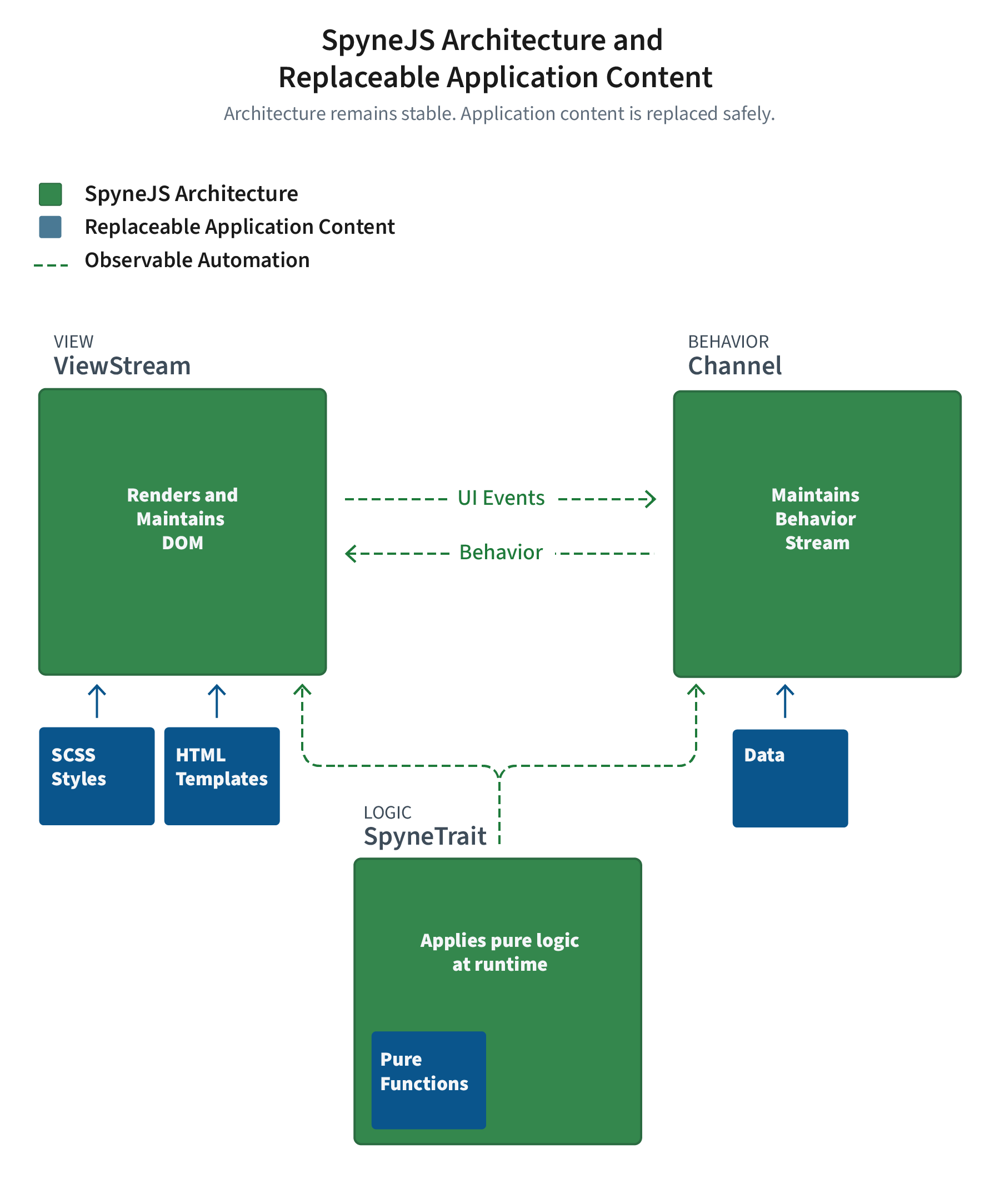
SpyneJS preserves VBL by combining explicit architectural boundaries with observable automation — keeping rendering, behavior, and logic automated while making cause and effect inspectable.
#Observable Automation in the VBL Architecture
This diagram shows how SpyneJS preserves automation while keeping architectural reasoning explicit.
Durable application architecture — shown in green — defines stable responsibilities for rendering, behavior coordination, and decision-making. Replaceable application content — shown in blue — is safely bounded within those structures and can evolve independently.
The dashed lines represent observable automation: automated processes that execute in the background while remaining explicit, inspectable, and structurally constrained.
- View (ViewStream): Rendering lifecycles are automated through a network of nested, encapsulated views. Each ViewStream maintains its own DOM lifecycle and can respond to observable behavior streams — including those emitted by its children — eliminating diffing while keeping rendering deterministic and traceable.
- Behavior (Channel): Browser APIs, user interactions, and data updates are automatically captured and unified into observable behavior streams. Event coordination and synchronization occur without implicit framework lifecycles or hidden state transitions.
- Logic (SpyneTrait): Pure logic is automatically composed into both View and Behavior layers at runtime. Logic remains isolated from rendering and synchronization concerns while fully participating in automated system behavior.
Because automation is observable, cause and effect remain visible. When something changes, it is possible to trace what triggered the update, how behavior was coordinated, and which logic produced the result. Automation accelerates execution, but reasoning remains intact.
The result is not less automation, but automation that serves architecture rather than obscuring it. Structure remains stable. Content remains replaceable. And both developers and AI can operate with speed and certainty inside explicit boundaries.
#AI as a Skeptical Evaluator
Asking AI to evaluate architectural approaches has become a practical part of modern development — not as an authority, but as a stress test. Used carefully, AI is effective at surfacing tradeoffs, boundary weaknesses, and structural ambiguity that may be difficult to see from inside a system.
The value here is not endorsement, but pressure.
The prompt below is deliberately skeptical. It can be used, modified, and applied with any modern AI model to evaluate VBL as an architectural pattern — not as an implementation, but as a system. The goal is to expose assumptions, identify failure modes, and clarify the conditions under which the architecture holds at scale.
#Run the Evaluation Yourself
The prompt above is offered for you to run, modify, and sharpen — against any model, with any additional context you choose. We publish it rather than a summary of its answers, because a summary of AI evaluations curated by the architecture's author is exactly the kind of claim this article argues against trusting.
For measured results rather than argued ones, there is now a better artifact: we ported Next.js's own tutorial application, had agents build against a versioned knowledge base, and published the numbers, the negative results, and the scoring receipts. That account is in Frameworks are starting to ship knowledge, not just code — this essay is the argument; that article is the measurement.
#A Shared Context for Architectural Evaluation
spynejs.ai runs the skeptical prompt above against a range of current models and publishes the responses side by side — a shared starting context for architectural evaluation, so skepticism can begin from the same ground rather than from isolated prompts.
#Inspecting the Architecture in Practice
The ideas presented here are meant to be inspected, not accepted on trust. To support that scrutiny, we provide a set of live examples where the VBL architecture can be reasoned about directly — in running code, in the browser.
Each example isolates a specific architectural concern: separating View from Logic, synchronizing behavior through observable streams, or enforcing lifecycle boundaries.
Links to live examples are provided in the repository README, with corresponding walkthroughs available at examples
#Thinking in VBL and SpyneJS
Anyone who has ever used a browser already understands the core sequence an application follows: content is displayed, interactions occur, and code determines what happens next. That mental model holds whether an application is small or sprawling. With VBL, the codebase grows, but the way you reason about it does not.
#The Natural Language of the VBL Pattern
Show this content (View), when this happens (Behavior), using this code (Logic)
Because reasoning is encoded directly into the structure, understanding no longer lives only in developers’ heads or in private teams’ conventions. You don’t have to infer intent from mixed concerns or reconstruct behavior by reading through layers of callbacks. Responsibilities are explicit, and the code reflects the same questions you naturally ask while building or debugging: What is being shown? What triggered this change? What decision determined the outcome?
The most noticeable shift is that Views stop being the place where everything happens.
They are no longer containers for logic, timing, and side effects. Instead, they focus solely on maintaining a single visual unit. With behavior and logic defined elsewhere, it becomes immediately clear how each View participates in the system as a whole. The application begins to read less like a collection of files and more like a schematic.
This has a direct effect on day-to-day work. You can think through presentation concerns without holding synchronization details in your head. You can reason about behavior and timing without worrying about rendering side effects. Application rules can be shaped and tested without loading the entire interface into context. Working memory stays local, even as systems grow.
Debugging changes character as well. Instead of tracing through implicit lifecycles or framework behavior, you can follow declared paths: what event occurred, which behavior responded, and what logic produced the result. When something changes unexpectedly, there is a visible place to look, rather than a need to guess.
Over time, this alters how teams collaborate. Code reviews focus on intent rather than archaeology. Onboarding becomes a matter of understanding clear boundaries instead of memorizing conventions. Most changes happen in areas designed to evolve, while the underlying structure remains stable. The result is not just cleaner code, but a calmer development experience — one where change feels deliberate rather than risky.
#SpyneJS as a Working Environment
Designing an architecture is only the first step. Keeping it intact under real delivery pressure — deadlines, team growth, and automated code generation — is the harder problem.
SpyneJS exists to make architectural drift difficult and architectural clarity the default. It does this by providing a working environment where responsibilities are not merely recommended, but structurally enforced. Each layer is given asymmetric capabilities that prevent concerns from silently recombining as systems evolve.
- Views can signal intent outward, but they do not define behavior.
- Behavior coordinates events and timing, but has no access to presentation.
- Logic remains isolated from both, unburdened by rendering or synchronization concerns.
These constraints are not conventions — they are properties of the environment. Boundary violations are constrained by design rather than discouraged by review or discipline.
Automation is preserved throughout. Rendering lifecycles, event coordination, and composition are handled automatically through observable pathways. Developers do not lose speed or convenience; they gain visibility into how and why changes occur.
Static application content is then given safe, explicit places to live and evolve. HTML templates are imported into Views as presentation assets — designed to express structure, bind data, and emit interaction signals, but not to encode application rules. By keeping templates declarative and free of decision-making, content changes remain local and predictable, while logic stays explicit and testable elsewhere.
This separation allows teams to iterate rapidly on interface and content without risking silent changes to behavior or intent. Structural wiring remains durable even as surface-level change accelerates.
Together, these constraints and affordances define the working environment: one where architectural intent is encoded once, preserved automatically, and insulated from the constant change that real applications — and AI-assisted workflows — introduce.
Developers spend less time protecting structure and more time evolving content, confident that the system itself will surface mismatches before they become invisible debt.
#The SpyneJS Platform
A working environment that preserves architectural intent does not emerge accidentally. It requires automation, constraints, and tooling that operate together as a system.
SpyneJS solves this by providing an environment where architectural intent is preserved by default — not through discipline, but through observable automation and structural constraints.
This is not about adding more rules. It is about removing the conditions under which clarity collapses.
#Observable Automation
In most frontend systems, automation obscures the very information needed to reason about change. Rendering, synchronization, and lifecycle management happen implicitly, forcing developers to guess why the system behaved the way it did.
SpyneJS inverts this model. Rendering lifecycles, event coordination, and data synchronization are fully automated — but along explicit, inspectable paths. When something changes, there is a clear place to see what happened, why it happened, and which part of the architecture was responsible.
Automation accelerates execution without obscuring cause and effect. This is the foundation that allows reasoning to survive scale.
#VBL Constraints
Automation requires boundaries. Without them, responsibilities inevitably recombine under pressure.
SpyneJS enforces separation through asymmetric capabilities. Views cannot define behavior; they can only signal intent. Behavior transmits events without touching the DOM. Logic remains isolated from both.
These constraints are not stylistic conventions; they are structural guarantees. Deviating from them is difficult by design, making the correct path the path of least resistance. Because architectural drift is structurally discouraged by the environment itself, invalid wiring surfaces immediately.
#The Behavior Console
When behavior remains visible, reasoning follows naturally.
SpyneJS treats observability as a first-class concern. Every action in the application is transmitted in real time and is inspectable via the Behavior Console.
This is not just a debugging tool; it is a verification of the mental model. Over time, developers internalize how events propagate. But when precision matters — synchronizing rendering cycles or validating new interactions — the architecture is never opaque. The system is always available for inspection.
#Replaceable Content
A common failure mode in AI-assisted development is allowing generated content to bleed into durable structure.
SpyneJS prevents this by isolating volatility. Templates and styles remain declarative and replaceable, while application logic stays explicit. AI assistance operates safely within these replaceable surfaces — generating content, views, and methods — without risking the durable architectural frame.
This allows teams to accelerate iteration without structural corruption. Change remains local, predictable, and reversible.
#Strict Mode
Some domains demand stronger guarantees. For these cases, SpyneJS provides optional strict modes that harden boundaries and prevent unsafe content execution. These modes do not alter the architectural model; they simply reinforce it where additional assurance is required.
#Controlled Integration
Extensibility is often where architecture leaks. In SpyneJS, a plugin is a complete application that connects to the host — speaking the same channels, bound by the same constraints. Extensions preserve existing boundaries instead of bypassing them, adding power without reopening ambiguity.
#Environment Agnostic
Architectural clarity should not depend on where the code lives. SpyneJS applications are environment-agnostic by design, supporting standalone deployment or embedding within existing systems. The structure remains stable even as the hosting context changes.
Over time, this environment becomes more than a framework. It becomes a stable foundation for development, authoring, and AI collaboration — one where automation accelerates change without obscuring meaning, and where architecture survives reality rather than collapsing under it.
#Why This Matters, Now
AI has accelerated structural tensions that were already present in frontend development. Practices that were manageable at human speeds — relying on unwritten rules, shared intuition, and implicit structure — are now buckling under the pressure of automated generation.
The industry’s response has been to inject structure from the outside. Prompts, specs, and layered instructions attempt to describe architectural intent that the codebase itself does not encode. In effect, we are compensating for systems that cannot explain themselves by continuously restating their rules.
This approach is understandable — but it has limits. Every request forces AI to re-derive the boundary between durable structure and replaceable content. The machine must guess what is safe to change and what must remain untouched, not because it lacks capability, but because the system offers no stable place to reason from.
When external specs and prompts become the source of truth, each iteration loses clarity instead of accumulating it. Understanding erodes, precision degrades, and long-term efficiency collapses because structure is repeatedly re-derived rather than preserved.
VBL represents a fork in the road. Instead of reconstructing architecture outside the system, it encodes reasoning directly into the codebase. Structure and content are separated by explicit constraints, not inferred rules. AI is no longer asked to guess at architecture; it operates within it.
This shift changes the role of natural language. It stops being a patch for missing structure and becomes a true collaboration medium. Teams move beyond managing chaos and toward systems that evolve deterministically — preserving control without surrendering the speed of automation.
#Architecture as Data
Once reasoning is encoded explicitly into a system, a further consequence follows naturally: the architecture itself becomes readable.
Not metaphorically, but operationally.
When responsibilities are clear, boundaries are enforced, and behavior flows through observable pathways, architecture no longer has to be inferred. It can be inspected, queried, and reasoned about directly. What was previously implicit — spread across conventions, documentation, and shared intuition — becomes explicit enough to function as data.
Any reason-based architecture that encodes intent structurally rather than descriptively will tend toward this outcome. SpyneJS represents an early, concrete exploration of what Architectural Data (AD) looks like when taken seriously in a production frontend system.
The distinction matters. Architecture as Data does not mean replacing code with schemas or serializing applications into configuration. It means that the system’s structure — its views, behaviors, lifecycles, and decision boundaries — is explicit enough to be traversed and reasoned about without reconstruction. The schematic is not documentation layered on top of the system; it is the system.
This changes the role of tooling fundamentally. Instead of operating outside the codebase — parsing files, guessing intent, or regenerating structure — tools can operate within the architecture itself. AI no longer needs to infer how a system is organized; it can read the organization directly. Change impact can be evaluated before execution. Reasoning becomes cumulative rather than repetitive.
For AI systems in particular, this is decisive. Pattern matching against opaque structures has natural limits. Reasoning against explicit structure does not. When architecture is data, collaboration shifts from speculative regeneration to informed evolution.
The stakes are mechanical, not stylistic: as automation accelerates change, architectures that cannot explain themselves require ever more external compensation — prompts, specs, restated rules — while architectures that encode reasoning directly do not. Over time that difference compounds.
SpyneJS is an early working surface for this shift — an explicit realization of Architectural Data in a production frontend system. The broader implication extends beyond any single framework: once reasoning is structural, architecture becomes something both humans and machines can read — and that claim is testable, which is why we test it.
#An Open Invitation
The ideas presented here are meant to be inspected, challenged, and tested against real systems. The architecture, the examples, and the evaluation process are designed to make reasoning visible — so conclusions can be reached independently, rather than accepted on trust.
SpyneJS and the VBL pattern are evolving in the open, shaped by real use, scrutiny, and informed disagreement. Engagement does not require alignment. It requires only a willingness to reason about structure directly — what holds, what fails, and under what conditions.
The documentation and examples at spynejs.com provide a concrete surface for inspection, allowing the architecture to be explored in running code and traced at your own pace. For those who prefer direct discussion — questions, objections, or alternative perspectives — I can be reached at frank@spynejs.com.
Frontend development has reached a point where speed is no longer the constraint. The limiting factor is whether systems can still be understood, evolved deliberately, and trusted over time. A future that maximizes both innovation and human understanding of code requires reason-based structures to take hold — structures that make intent explicit rather than inferred, and evolution cumulative rather than regenerative.
This project exists to explore that direction in practice.